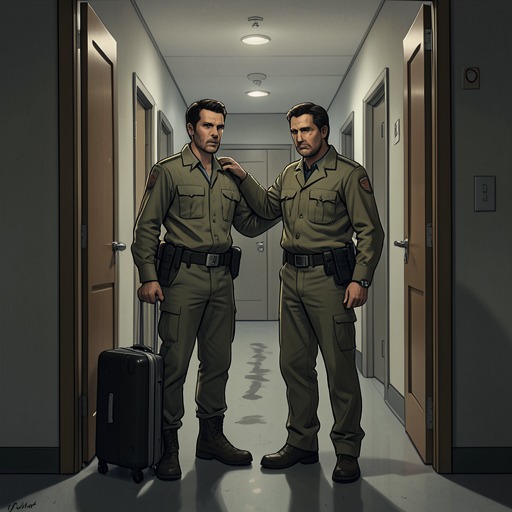
Hardin tries to win Tessa back, and they kiss in the apartment
After We CollidedHardin Scott tries to reclaim his relationship with Tessa Young just as she is preparing to leave their apartment, and their reunion briefly turns into a kiss before Tessa ends it. The scene’s decisive movement is not from separation to reconciliation but from temptation to renewed refusal: the kiss exposes the strength of their attachment without undoing the betrayal or restoring Tessa’s trust.
The departure interrupted
Tessa arrives at the apartment intending to move on. She packs her books into a box and takes Hardin Scott’s copy of Wuthering Heights, reasoning that he will not miss it and that she is owed something after what he has taken from her. While she sits alone, she allows herself to imagine an alternative in which Hardin comes home, tells her he loves her, and welcomes her back. The imagined reunion makes the actual one more painful: when the door clicks, Hardin enters looking over his shoulder at a brunette woman in a black sweater dress.
Hardin does not notice Tessa at first. When he does, her bags on the floor make clear that she is leaving. He asks the other woman to give them a minute, and she waits in the building hallway. Tessa says she was just leaving. Hardin asks to explain himself, and the dark circles under his eyes suggest that he, too, has been affected by the separation, but his distress does not persuade Tessa that he can be trusted. When she reaches for her bags, he takes them and drops them back onto the floor. Tessa agrees to hear him out because she believes she needs closure, not because she has decided to stay.
A plea that cannot restore trust
Hardin tells Tessa that he loves and needs her and asks for a chance to make things right. Tessa interprets his appeal through the betrayal she has discovered: while she was falling in love, she believes he was using her and treating their relationship as a game. The scene gives his declaration emotional force, but it also shows why the declaration is insufficient. Tessa remembers that he once made her happy, yet that memory cannot cancel what she now understands about the way their relationship began.
Hardin’s insistence intensifies rather than settles the disagreement. He frames Tessa as essential to his life, but she does not accept his need as proof that he has changed. Her purpose in listening is explicitly forward-looking: she wants to hear him so that she can move on. The distance between those aims matters. Hardin is asking for another chance; Tessa is trying to bring their conversation to an end without being pulled back into the relationship.
The kiss and Tessa’s refusal
As the argument escalates, Hardin abruptly pulls Tessa into a kiss. She responds instinctively for a moment, before her judgment catches up with the situation; she then tries to push him away, and he holds her wrists as the kiss continues. The narrative presents the moment as a collision between remembered intimacy and present harm. Tessa’s response does not erase her refusal or transform the kiss into a resolution: she eventually pulls away, turns her head when Hardin tries to kiss her again, and tells him no.
Hardin asks her to stay. Tessa acknowledges privately that she wants to remain with him and still loves him, but she also refuses to return to a pattern in which her feelings allow a man to do whatever he wants. That distinction gives her departure its force. Leaving is not evidence that her attachment has vanished; it is a decision to protect her ability to choose despite that attachment. When Hardin asks where she will go, she says she does not yet know and mentions that her mother is trying to get her back into a dorm. She tells Hardin that he does not need to know her location, then gives him a false explanation that Noah and her mother are waiting. She takes her bags and walks out. Hardin does not follow, and Tessa does not turn around to see his reaction.
Aftermath and the unresolved pattern
The encounter supplies no clean reconciliation. The kiss briefly revives the closeness Tessa has imagined and still desires, but her clear refusal and departure preserve the separation. Its emotional turn is therefore deliberately incomplete: physical familiarity pulls against the damage to trust, and the decision to leave carries more weight than the momentary return of intimacy.
Later conversations make explicit what the apartment scene leaves unresolved. Tessa tells Hardin that any attempt to move forward requires him to open up about how he feels; when he points out that she has also kept her feelings unclear, she recognizes that confusion has prevented her from communicating what she wants. She describes herself as confused about their relationship and his betrayal. In another confrontation, she explains that she feels she never comes first, that he has not considered her choices or future, and that she wants security even though she is not asking to marry immediately. She connects this frustration to his having stayed out all night while drunk with another woman. These later complaints show that declarations of love and moments of renewed closeness do not, by themselves, settle the questions of honesty, consideration, and trust that shaped her departure.
The scene thus serves as an early test of whether longing can substitute for repair. It cannot: Tessa’s feelings remain real, but she refuses to treat them as permission to overlook the betrayal or surrender her independence. Hardin’s failure to follow her leaves the encounter at that boundary. The apartment becomes a place where the couple’s pull toward one another is unmistakable, yet where Tessa’s choice to leave is equally decisive.